2025-12-04
- 分享
-

-


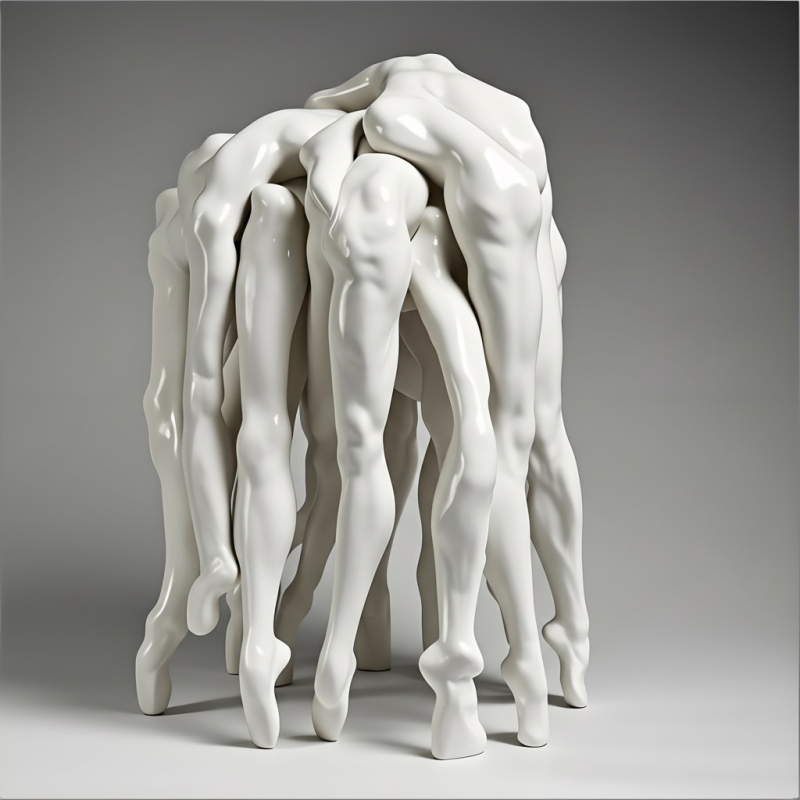
The collective
● Artist: Gao Shang
● Work Title: Collectivity Within
● Dimensions: 25*17*17 cm
● Material: Ceramic
An In-depth Interpretation of the Surreal Ceramic Body Sculpture from the Perspective of "Individual Differences and Collective Relationships"
This ceramic sculpture centered on the legs of ballet dancers is not merely a creative work of form, but a surreal visual metaphor for the relationship between "individuals and the collective". Every twist and stack of the body parts holds a delicate inquiry into the tension between the two.
I. The "Convergence" of Body Parts: The Dissolution of Individual Differences by the Collective
The most intuitive visual impact of the work lies in the "high uniformity" of all the ballet dancers' legs—there is no detail that can distinguish "whose leg this is": the curvature of the lines is deliberately polished to be almost identical, the style of the pointe shoes and the luster of the pure white glaze are completely uniform, and even the angle of inclination of the body parts is deliberately designed to avoid "personalized traces" (such as the subtle differences in muscle texture or the unique body habits of each dancer).
This "de-differentiated" treatment is much like the "disciplining process" imposed by the collective on individuals in reality: when an individual enters a certain collective (such as a workplace or a community), they often take the initiative to hide their unique traits (such as setting aside niche hobbies or adjusting their words and deeds) just to conform to the "unified standards" of the collective. By replacing the "vibrant differences of the human body" with the "cold regularity of ceramics", the sculpture essentially transforms the abstract process of "the collective dissolving individual characteristics" into a visible form. What the viewer sees is not a group of dancers with distinct personalities, but "body parts symbolized by the collective", and this visual experience precisely corresponds to the resonant reality of modern people "gradually losing their sense of identity within the collective".
II. The "Tension" in Twisting: The Symbiosis and Opposition Between Individuals and the Collective
A closer look at the way the body parts are twisted reveals an underlying "opposition" behind the apparent "tightness": some legs stretch upward but are tightly wrapped by the surrounding body parts; some seem to be supporting the whole but are actually in a suspended state, as if they might break away at any moment; others are squeezed against each other, and the curvature of the joints reveals a sense of tightness as if "being forced to deform". These details break the one-sided perception that "the collective is a warm haven" and expose the contradictory nature of the relationship between individuals and the collective:
• Symbiosis: No single body part can exist independently, and the stability of each leg depends on the support of the surrounding body parts. This is analogous to how individuals rely on the sense of belonging, resources, and rules provided by the collective to gain a foothold in society.
• Opposition: The twisted and squeezed forms of the body parts implicitly symbolize the "lack of freedom" of individuals within the collective. The rules of the collective may restrict individuals' self-expression, and the will of the collective may override the needs of individuals. Just like the body parts in the sculpture that "want to break free but cannot", it accurately reflects the tangled state of modern people "relying on the collective while longing to escape from it".
III. The "Contradiction" of Materials: The Significance of Individual Differences to Collective Stability
The "fragility" of ceramics and the "dense and solid" form of the sculpture form a key metaphorical relationship. On the surface, the "collective form" formed by the stack of numerous body parts is full of a sense of strength, as if it is indestructible. However, in essence, every "body part" that constitutes the collective is made of fragile ceramics—if even one of them breaks, the entire structure may collapse.
Beneath this lies the work's core reflection on the "relationship between individuals and the collective": the stability of the collective is never achieved by "dissolving individual differences", but rather relies on "individual characteristics" as its support. Just as in the sculpture, if all body parts were completely identical without any tension, they would be more prone to breaking due to "lack of flexibility". Conversely, those individual body parts with implicit "sense of opposition", although seemingly "undermining unity", actually provide the vitality for a "dynamic balance" to the collective form.
This also holds true when mapped to reality: a healthy collective will not demand complete "convergence" from individuals, but will instead tolerate and even encourage individual differences. For it is the uniqueness and creativity of individuals that serve as the key to maintaining the collective's vitality and resisting "rigidity and collapse"—this is the most profound annotation of the work beyond its visual appeal, regarding the "symbiosis between individuals and the collective".
2025-12-04

评论 0